Ghost Rider - Halloween Omni Wheel Robot. Advanced classes
VAT inc
Available for: 11+ years old
5 days, from 19 Oct'26 - 23 Oct’26
From 12.30 until 15.30
Ghost Rider - Halloween Omni Wheel Robot
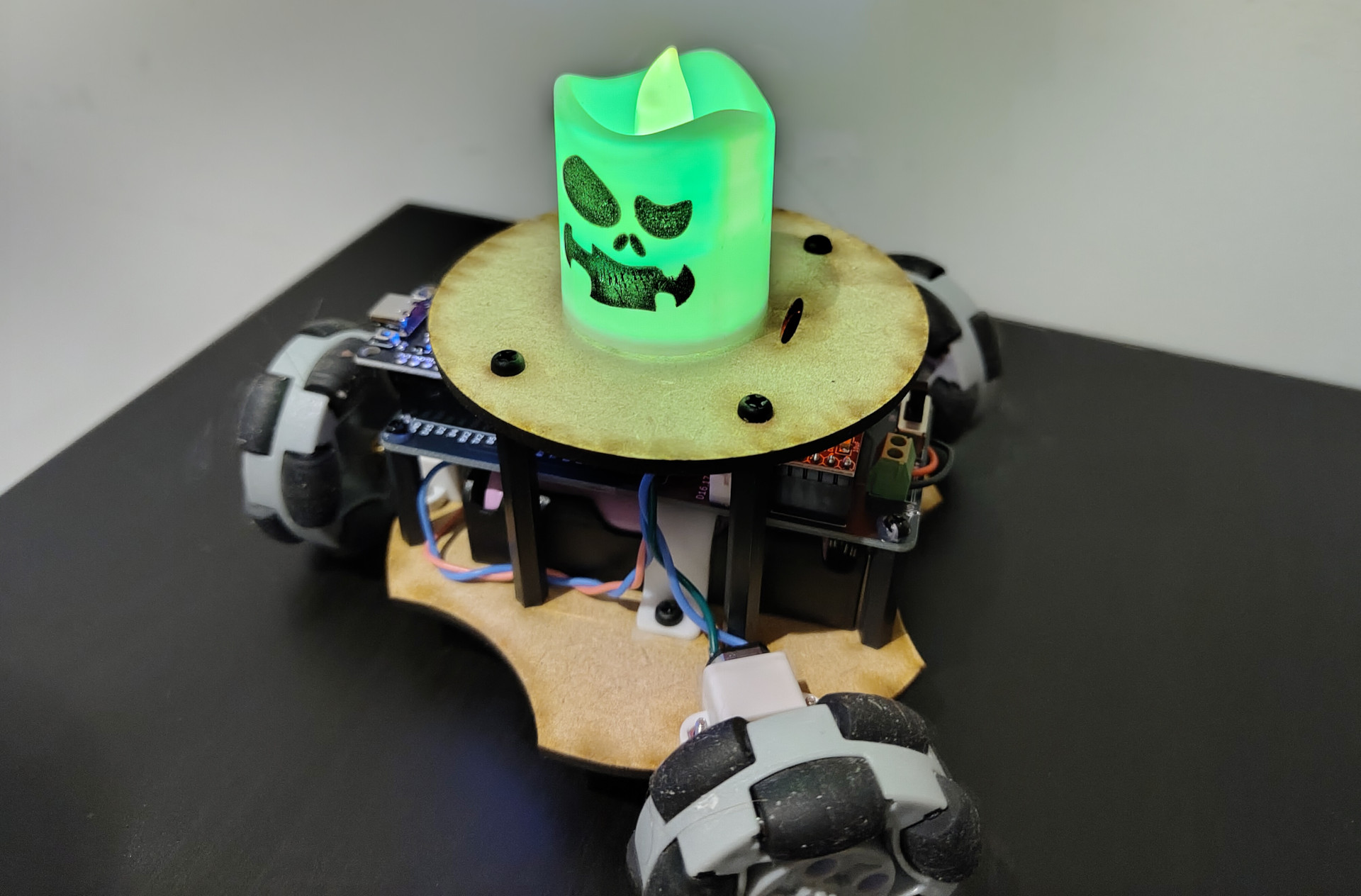
Ghost Rider is a Halloween robotics project for students aged 11+. In this project, students build and program a Bluetooth-controlled robotic car that carries a small electric ghost candle. The robot uses three omni wheels, allowing it to move forward, backward, rotate, and slide sideways in a way that ordinary wheeled robots cannot.
Students program the robot using the Arduino IDE and Arduino C, giving them direct control over the robot’s motors and movement logic. They learn how to define motor pins, write movement functions, control motor direction, and structure their code so the robot can respond to wireless commands from a Bluetooth ring controller.
The robot is built around an ESP32 microcontroller, three DC motors, and motor driver modules. Students explore how a microcontroller sends digital and PWM signals to motor drivers, and how these signals are converted into real movement. They also learn why motor direction, wheel placement, and speed balancing are important for creating smooth omni-wheel motion.
The Bluetooth ring controller makes the project interactive and practical. Students write code that receives wireless commands and translates them into robot behaviour, such as moving forward, reversing, turning, stopping, or sliding sideways. This helps them understand how embedded software connects user input with physical hardware.
For the Halloween theme, the finished robot carries a small plastic electric candle with a ghost face, turning the project into a moving ghost light. The creative theme makes the project fun, while the engineering behind it remains real and technically meaningful.
During the project, students practise circuit building, motor testing, debugging, code organisation, and movement calibration. They learn that a robot rarely works perfectly on the first try, and that good engineering means testing each subsystem, finding mistakes, and improving both the wiring and the software.
By the end of the project, each student will have built and programmed a working Bluetooth-controlled Ghost Rider robot and will understand the core principles of DC motor control, wireless communication, embedded programming, and omni-wheel movement.
That is take home project!
The Camp Dates and Time
5 days, from 19 Oct'26 - 23 Oct’26
Start at 12.30 until 15.30
Age: from 11 years old (to 17)
Location
Richmond and Hillcroft Adult Community College.
Parkshot, Richmond TW9 2RE
The closest parking at the Old Deer Park (Extension).
Learning outcomes
- Understand how omni-wheel robots move
Students learn how three omni wheels can be combined to create forward, backward, rotational, and sideways movement.
- Program a robot using Arduino C
Students use the Arduino IDE to write structured C/C++ code for controlling a real robotic system.
- Control DC motors with motor drivers
Students learn how an ESP32 controls DC motors through motor driver modules and how motor direction is changed using digital output pins.
- Use PWM to control motor speed
Students explore how PWM signals allow the robot to move more smoothly and how speed balancing improves omni-wheel motion.
- Build a complete embedded robotics system
Students connect DC motors, motor drivers, an ESP32 controller, batteries, and a Bluetooth controller using a structured wiring diagram.
- Learn how Bluetooth commands control hardware
Students receive wireless commands from a Bluetooth ring controller and translate them into movement functions in code.
- Develop modular movement code
Students create reusable functions for forward, backward, stop, rotate, and sideways movement, improving code structure and readability.
- Debug motor direction and movement behaviour
Students test each motor individually, identify incorrect directions, and adjust code or wiring to correct the robot’s motion.
- Develop engineering and problem-solving skills
Students refine the robot by testing wiring, motor direction, wheel alignment, PWM values, and movement calibration.
- Gain confidence with real robotics hardware
By building and programming their own Halloween-themed Ghost Rider robot, students see how electronics, mechanics, wireless communication, and embedded software work together in a complete robotics project.
There are some requirements exist for the course:
1. You must be confident in using a computer, keyboard and mouse. At the good user level.
2. Know how we save files on a computer, what a file and folders are, etc.
3. Be able to switch between windows in the operating system. Use the keys’ shortcuts.
4. No previous experience with 3D modeling is required.
5. No previous experience in Robotics is required.
6. You want to program robots and are not afraid to struggle with the difficulties of learning them.
7. Minimum previous experience with text-based programming is required. Ideally, you are able to make a program that performs basic maths operations with numbers. The programming language itself is not important.