Kinetic Pterodactyl: Light, Motion & Code

Kinetic Pterodactyl: Light, Motion & Code

11+ Camps

VAT inc
Available for: 11+ years old 

4 days, from 07 - 10 Apr’26

From 12.30 until 15.40

Request Info

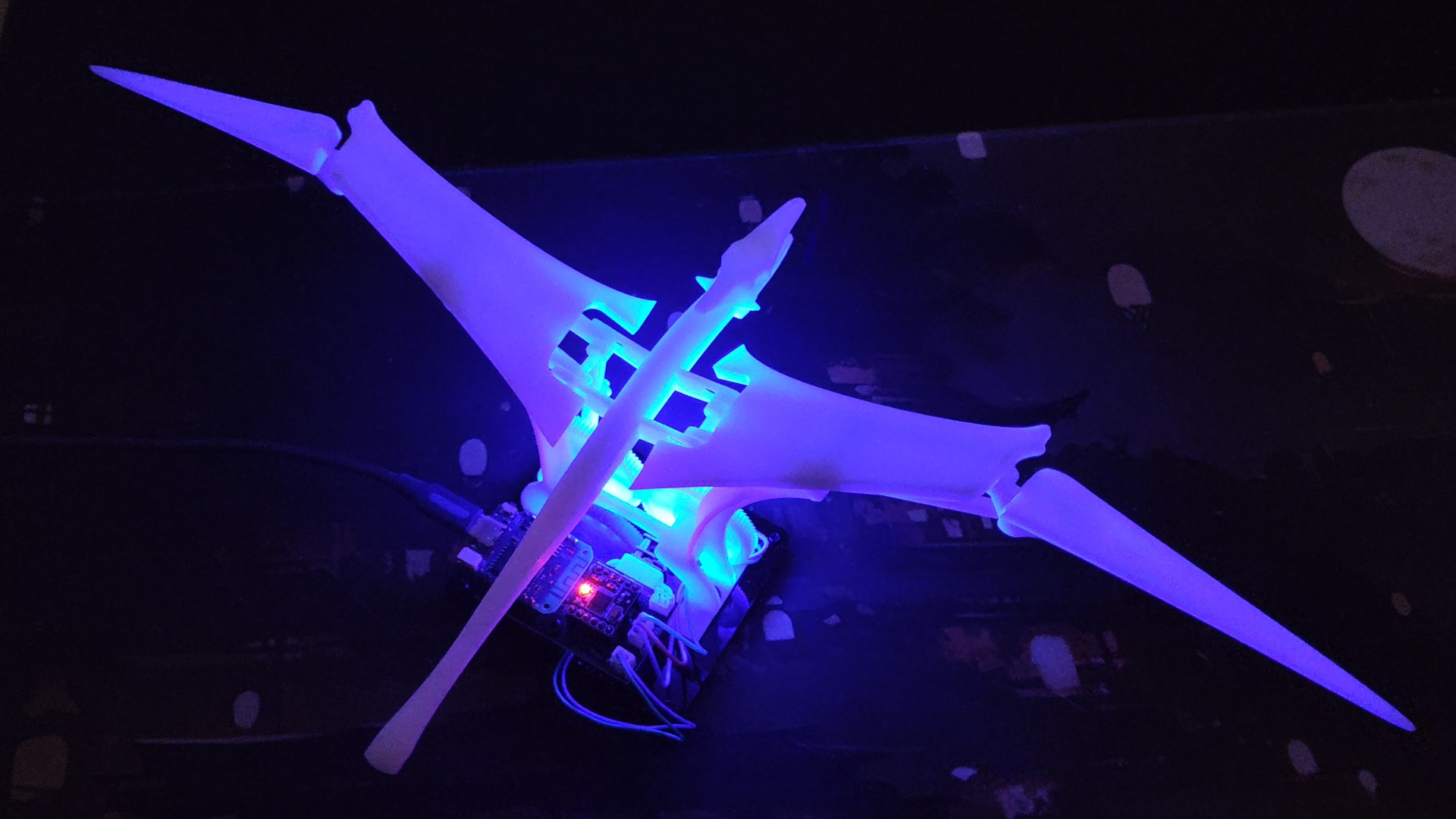
Kinetic Pterodactyl is a hands-on educational robotics project designed for a creative STEM camp, where pupils build, program, and take home a fully working kinetic sculpture. Inspired by classic bird flapping mechanisms, the project replaces the bird with a dynamic pterodactyl whose wings flap realistically using a gear-based mechanical system.


At the heart of the model is a DC motor driven through a DRV8833 motor driver, controlled by a LoLin (ESP-based) board. Students assemble the mechanical transmission themselves --gears, shafts, and linkages, learning how rotational motion is converted into rhythmic wing flapping. Beneath the pterodactyl, an LED strip provides expressive under-lighting, transforming the model into a glowing kinetic display.


Beyond mechanics, pupils program the system to control motor behavior and design custom LED color patterns. They experiment with speed, direction, timing, and light animations, gaining practical experience in embedded programming and creative problem-solving. The project blends engineering, coding, and art into a single engaging build -- and at the end of the camp, every pupil proudly takes their animated pterodactyl home.


That is take home project!


The Camp Dates and Time


4 days, from 07 - 10 Apr’26

Start at 12.30 until 15.40


Age: from 11 years old


Location


Richmond and Hillcroft Adult Community College.

Parkshot, Richmond TW9 2RE
The closest parking at the Old Deer Park (Extension).
The learning outcomes

  • Understand the basics of how a flapping mechanism converts rotational motion into wing movement.
  • Understand the basics of how a differential gear works.
  • Learn how electric motors create movement.
  • Assemble a working kinetic model from modular mechanical parts.
  • Control motor speed and direction using a motor driver (DRV8833).
  • Program motor behaviour using an ESP-based Lolin board.
  • Design dynamic LED light patterns.
  • Create programs using Arduino C programming.
  • Draw a basic wiring diagram in Fritzing.
  • Take home a fully working kinetic pterodactyl they built themselves.

There are some requirements exist for the course:


1. You must be confident in using a computer, keyboard and mouse. At the good user level.


2. Know how we save files on a computer, what a file and folders are, etc.


3. Be able to switch between windows in the operating system. Use the keys’ shortcuts.


4. No previous experience with 3D modeling is required.


5. No previous experience in Robotics is required.


6. You want to program robots and are not afraid to struggle with the difficulties of learning them.


7. Minimum previous experience with text-based programming is required. Ideally, you are able to make a program that performs basic maths operations with numbers. The programming language itself is not important.